Shared roots · Historical divisions · Churches today | Full edition
The historical relationship between Judaism, Catholicism, Eastern Orthodoxy and Protestantism
Where did these faith traditions come from? How were they originally related, and why did they gradually part ways?
Begin with the Jewish background, explore the early church, the divisions of the ancient churches, the East–West Schism and the Reformation, and then make sense of today’s denominations and movements across denominational boundaries.
Understanding the relationships first
These names do not all belong to the same level of classification
Catholicism, Eastern Orthodoxy and Protestantism are not unrelated religions worshipping different deities. They all belong to Christianity and share a history, while developing different traditions of church authority, doctrine and liturgy. Judaism is a separate religion with deep historical connections to Christianity.[2][3][4]
Judaism
A tradition continuing the faith and scriptures of Israel. It generally does not accept Jesus as the Messiah confessed by Christianity and is not part of Christianity.
Christianity
The broad name for the religion centred on Jesus Christ, encompassing Catholicism, Eastern Orthodoxy, Protestantism and other ancient Eastern churches.
Catholicism
The church in communion with the Pope in Rome, led by the Pope and the college of bishops. It values Scripture, Sacred Tradition and the sacraments.[9]
Eastern Orthodoxy
Comprises several self-governing churches, values joint decision-making by bishops and the heritage of the ancient church, and does not accept the Pope’s universal jurisdiction.[5]
Protestantism
The diverse church traditions formed after the sixteenth-century Western Reformation. It is not one church and has no single common headquarters.[4][10]
Other ancient Eastern churches
These include Oriental Orthodoxy and the Church of the East, whose paths gradually diverged before the great East–West Schism. They are not the same as Eastern Orthodoxy.[6][7]
A frequent source of confusion in Chinese: Jidujiao can broadly mean Christianity as a whole, but in everyday Taiwanese speech it often refers specifically to Protestantism. Catholics are therefore also Christians in the broader sense.[3]
Terms to know: “Sacred Tradition” means the church’s transmitted teaching and life of faith. “Communion” refers to connections in faith, sacraments and church life.
Shared roots | First–third centuries
From the Jewish religious background to the early church
Christianity did not begin by setting up today’s denominational structures before proclaiming its faith. It began with people in the first-century Jewish world who believed that Jesus was the Christ.[1][2]
Jesus and his earliest disciples came from the Jewish world
Jesus and his earliest disciples were Jews who inherited belief in one God, Israel’s history and the Hebrew Scriptures. After Jesus was crucified, the disciples proclaimed that he had risen and believed him to be the Messiah promised by God. “Christ” is the Greek title corresponding to “Messiah”, meaning “anointed one”; it is not Jesus’ surname.[1][2]
Gentiles joined: the community was no longer limited to one people
Paul and others preached the gospel to non-Jews. Acts 15 records an important debate about whether Gentile believers had to be circumcised and observe the Law of Moses. This was not simply a change in meeting style: it concerned how non-Jews could join this community of faith.[2]
Christian confessions about Jesus, the inclusion of Gentiles, and later social and political changes gradually shaped the boundaries between Judaism and Christianity. The process was not identical everywhere. Judaism also continued developing its own traditions; it should not be portrayed as frozen in the past and later renamed Christianity wholesale.[2]
The early church is a shared point of reference for the later major traditions
Believers gathered in different places to worship, pray, baptise, break bread and support one another. Church ministries, statements of faith and the recognition of scriptures developed gradually. The first-century church should not be drawn as a miniature version of all today’s denominations.[1][2]
“The disciples were first called Christians in Antioch.”
Acts 11:26 (English rendering of the Chinese Union Version)
The passage concerns the formation and teaching of the community in Antioch, not a distinction between the later Catholic, Eastern Orthodox and Protestant traditions.
Remember: Christianity arose within a Jewish historical and religious background, but Judaism is not a Christian denomination and did not disappear when the early church emerged.
Empire and early divisions | Fourth–fifth centuries
The church expanded, and lasting differences began to develop
Christians faced persecution in the Roman Empire at different times, but conditions were not the same throughout the first three centuries. After policy changed in the fourth century, the church’s public activities, organisation and political influence expanded significantly.[1][2]
313 | Religious toleration. Constantine and Licinius pursued a policy of toleration, allowing Christians to practise their faith more openly.
325 | Council of Nicaea. It addressed disputes including the relationship between the Son and the Father, affirming that the Son is “of one substance” with the Father. Belief in Christ’s divinity did not begin for the first time at this council.
380 | Official status. Nicene Christianity received the status of the Roman Empire’s official religion. This was not the same event as the religious toleration of 313.[1][8]
Earlier divisions: more than an Eastern and a Western path
Churches increasingly asked how Jesus could be fully divine and fully human. Differences of language and theological expression, conflicts among bishops and imperial politics became intertwined in long-lasting disputes.[6][7][19]
Church of the East
An ancient church tradition in Mesopotamia, Persia and elsewhere, not a collective term for all churches “in the East”. It gradually developed independently around the fifth century, in connection with political borders, church organisation and Christological controversies. Today’s Assyrian Church of the East continues this tradition.[7][19]
Oriental Orthodoxy
In 451 the Council of Chalcedon described the union of full divinity and humanity as “one Christ in two natures”. Some churches did not accept this definition and later formed the Oriental Orthodox family, including the Coptic Orthodox Church and the Armenian Apostolic Church.[6]
Do not reduce the dispute to “one side believed Jesus was only God, and the other that he was only human”. These ancient churches all confess Christ’s divinity and humanity. The controversy concerns how their union is understood and expressed.[6][19]
313 was not the year Christianity was founded, and Constantine was not the founder of the Catholic Church. Churches in Rome and elsewhere already existed.
The East–West Schism | Around 1054
Why did Catholicism and Eastern Orthodoxy separate?
Church centres such as Rome and Constantinople shared a long history but gradually accumulated differences over authority, theology, language and politics. 1054 is a representative date for the great East–West Schism, not the founding year of Catholicism or Eastern Orthodoxy.[5][8][18]
1. How extensive should the Bishop of Rome’s authority be?
The West increasingly emphasised the Pope’s supreme jurisdiction over the whole church. The East valued bishops of local churches making decisions together. Recognising Rome’s important position in antiquity does not mean accepting the universal jurisdiction later claimed by the Catholic Church.[5][8]
2. Can one side add to a shared creed?
The West added the Filioque, “and the Son”, to the creed, stating that the Holy Spirit “proceeds from the Father and the Son”. The East objected not merely to extra words, but also to how relationships within the Trinity should be expressed and whether one side could alter a shared creed on its own. This was not a case of “one side not believing in the Holy Spirit”.[8]
3. Cultural and political conflict deepened the rupture
Differences between the Latin- and Greek-speaking worlds, the interests of competing political powers and liturgical disputes increased estrangement. The excommunications of 1054 principally concerned the people involved; they did not mean that the entire Eastern and Western churches simultaneously severed relations in a single day. The capture of Constantinople by the Fourth Crusade in 1204 deepened distrust.[5][8][18]
Catholic continuity: communion with the Pope in Rome became an important institutional boundary. Led by the Pope and the college of bishops, the church continued and developed its sacramental, doctrinal and liturgical traditions. Eastern Orthodox continuity: several self-governing churches value joint decision-making by bishops, without a leader who has authority equivalent to the Roman Pope’s over all churches.
The story is more complex than “a parent church existed first, then the other side founded a new religion”. Both inherit the ancient church’s traditions from before the separation. Today’s institutional boundaries gradually became fixed through a long process of estrangement.[5][8][9]
“Greek Orthodox” and “Russian Orthodox” usually refer to different church traditions within Eastern Orthodoxy, not two additional religions. Neither is the same as Oriental Orthodoxy.[5]
The Western Reformation | Sixteenth century
Where did Protestantism come from, and why did it take several paths?
In 1517 Martin Luther put forward the Ninety-Five Theses, criticising the promotion of indulgences and related abuses. This became an important starting point of the Reformation. Disputes initially focused on church practices gradually broadened to salvation, authority and the whole of church life.[1][10]
Core questions · Where did disagreements arise?
How are people saved?
Reformers emphasised God’s grace and justification by faith. “Justification” asks how a person is counted righteous before God.
What is the standard for faith?
How does Scripture relate to the Pope, councils and church tradition? Protestantism generally emphasises Scripture’s supreme normative authority.
How should the church worship and be governed?
Which aspects of the Lord’s Supper, baptism, ministry and liturgy should be retained or reformed? Reformers themselves gave different answers.
Who has authority to carry out reform?
Relationships of power among rulers, cities and churches led reforms in different directions. This was not a purely academic debate.
This comparison summarises major disputes; it does not mean that every reformer or region held the same position.[1][10][11][12]
Why was there no single, united Protestant church?
Lutheranism in German lands, the Reformed tradition in Switzerland and elsewhere, and Anglicanism in England had different backgrounds. They did not agree on the Lord’s Supper, church structures or church–state relations. Protestantism therefore had several paths from the beginning. Luther did not establish a single central church from which all denominations were later organised as branches.[10][11][12]
The Catholic Church also undertook reforms of its own
Through reforms including the Council of Trent (1545–1563), the Catholic Church responded to doctrinal controversies, reformed church life and improved clergy formation. This history cannot be reduced to “reforming Protestants” versus “Catholics who never changed”.[1][9]
It is not a matter of “Protestants relying on faith, while Catholics buy salvation with money or good works”. Catholicism also emphasises grace. The disputes concern the relationship between grace, faith, the human response and the renewal of life.[9][20]
Xinjiao, Gengzhengjiao and Kangyizong are Chinese translations of “Protestantism”. The word “new” in Xinjiao marks a historical branching, not belief in a new God.
Traditions within Protestantism
How Presbyterian, Baptist and Methodist churches are related
Protestant denominational names may derive from reformers, theological traditions, church government or religious practices. They have shared roots, but not every tradition branched directly from another, and not every difference began with the same dispute.[4][10][11][12][13][14]
Common name · Historical relationship · Main features
Lutheran churches
Historical relationship: The sixteenth-century German Reformation
Main features: Continues Martin Luther’s Reformation, emphasising God’s grace and justification by faith.[10]
Reformed churches
Historical relationship: The sixteenth-century Reformation in Switzerland and elsewhere
Main features: Associated with Zwingli, Calvin and others; emphasises God’s sovereignty, Scripture and church reform.[11]
Presbyterian churches
Historical relationship: An important branch of the Reformed tradition
Main features: Not a separate tradition unrelated to the Reformed churches. The name highlights shared government by elders and church councils.[11]
Anglican churches
Historical relationship: The sixteenth-century English Reformation
Main features: Developed independent structures amid political and theological changes, retaining episcopal government and traditional liturgy.[12]
Baptist churches
Historical relationship: Seventeenth-century England and communities in exile in the Netherlands
Main features: Emphasises baptism after a personal profession of faith and local church autonomy, rather than infant baptism.[13]
Methodist churches
Historical relationship: An eighteenth-century revival within the Church of England
Main features: Associated with John Wesley and others, later forming independent churches; emphasises sanctification and social concern.[14]
Some divisions involved doctrine; others involved revival and organisational development
Baptists emphasise that those baptised should personally profess their faith, distinguishing them from churches that practise infant baptism. The Methodist movement arose from revival and pastoral work within Anglicanism and later gradually established independent organisations. Not every division can be explained solely as a struggle for power or someone’s decision to start a separate organisation.[13][14]
Remember two relationships: Reformed → Presbyterian: shared theological and historical roots. Revival within Anglicanism → Methodism: a historical origin, not a present-day relationship of institutional subordination.
This is not a complete list of denominations. A single tradition may also have different assemblies or unions in different countries.
Modern developments | Revival and cross-denominational movements
How do denominations, evangelicalism and charismatic movements differ?
Modern times saw many movements and orientations of faith emerge alongside denominations. “Denomination”, “evangelical” and “charismatic movement” are not classifications at the same level. One church may relate to several at once.[4][15][16]
Pentecostalism: a revival movement that formed several denominations
The early twentieth-century Pentecostal movement drew partly on holiness and revival movements, particularly emphasising baptism in the Holy Spirit, speaking in tongues and other gifts. The 1906 Azusa Street Revival in Los Angeles was an important centre of its spread, but not its only source. Several denominations and independent churches later developed.[15]
Charismatic renewal: also found within existing churches
From the mid-twentieth century, movements emphasising gifts of the Holy Spirit also entered established Protestant churches; participants did not necessarily leave their denominations. Catholic Charismatic Renewal began in 1967 and belongs to this wider cross-church context. “Charismatic” is therefore not the name of one unified organisation.[15][17]
Evangelicalism: a cross-denominational orientation of faith
Usually emphasises biblical authority, personal conversion, Christ’s redemption, evangelism and putting faith into practice. It can be found in Baptist, Presbyterian, Methodist and other traditions. Evangelicalism is not one denomination, nor is it identical to Pentecostalism or charismatic movements, although they may overlap.[16]
Independent or non-denominational: mainly an organisational description
These churches may not belong to a traditional denomination, but can still inherit a particular theology, join church networks or have their own systems of oversight. “Non-denominational” does not mean “without doctrinal positions”. A church’s sign does not reveal everything it believes.[4][15][16]
Consider a hypothetical example: a church is organisationally Baptist, broadly evangelical in theology, and accepts some charismatic teachings. These three labels answer different questions and need not be mutually exclusive.
Do not classify a church solely by the atmosphere of its services. A worship band, raised hands during singing or fervent prayer cannot by themselves establish its tradition. Consider its formal confession of faith, teaching and organisational relationships.
Historical timeline
Major turning points from the early church to modern times
Read together, this history shows that the early church did not split into today’s traditions all at once on a particular day. The dates below mark important turning points, not the “founding dates” of all churches.
First century
The early church. Jesus’ disciples proclaimed his resurrection; communities of believers gradually expanded from the Jewish world to Gentiles.
313
Religious toleration. Constantine and Licinius pursued a policy of toleration, allowing Christians to practise their faith more openly.
325 and 380
Doctrine and imperial status. The Council of Nicaea addressed disputes over Christ’s divinity; Nicene Christianity acquired official imperial status in 380.
Fifth century
Earlier Eastern divisions. The Church of the East gradually developed independently; Oriental Orthodox churches became separate after the controversy over Chalcedon in 451.
Around 1054
East–West separation. Differences over authority, the creed, politics and culture accumulated; the Crusaders’ capture of Constantinople in 1204 deepened the rupture.
From 1517
The Western Reformation. Several Protestant reform traditions gradually formed; the Catholic Church also pursued doctrinal responses and institutional reform.
Seventeenth–eighteenth centuries
Further denominations took shape. Baptist and Methodist movements developed in succession, reflecting differences over baptism, church government and religious practice.
Twentieth century
Revival, mission and dialogue. Pentecostalism, charismatic movements and evangelical networks developed. Different churches also pursued reconciliation and theological dialogue.
Three key divisions: ancient Eastern churches were already separating in the fifth century; around 1054 marks the long-term separation of East and West; the sixteenth-century Reformation occurred mainly in the West and contributed to the formation of Protestantism.
This timeline covers major historical turning points and is not drawn to a chronological scale. Sources: [1][5][6][7][10][13][14][15][18][20]
The main family tree
How did shared roots develop into different church traditions?
This diagram presents the main historical relationships. It does not rank denominations as more or less correct, nor suggest that local churches had no differences before the divisions.
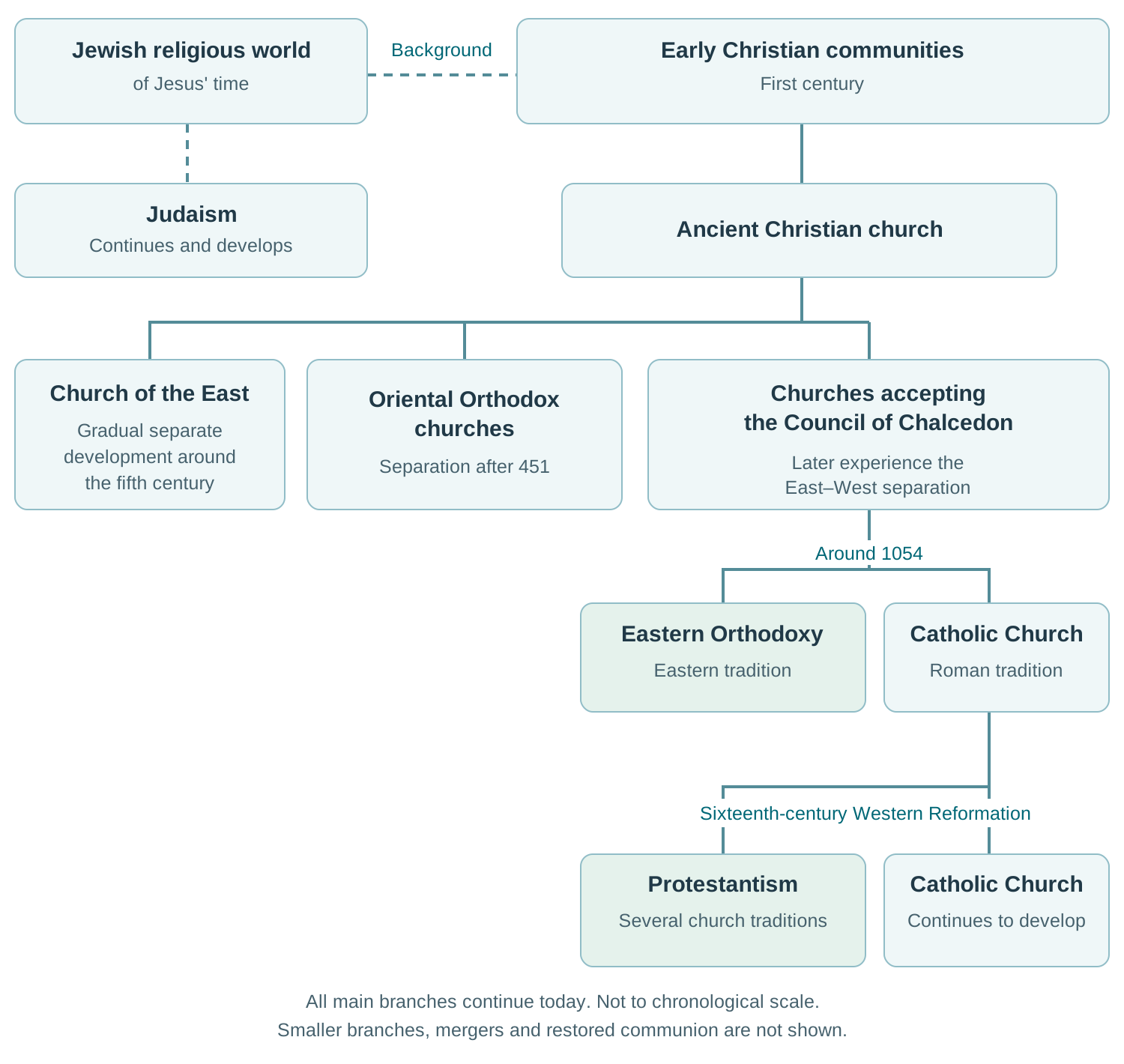
On a phone, scroll sideways to see the whole diagram, or tap it to open the full-size image and zoom in.
Diagram in words
- The Jewish religious world of Jesus’ time forms the background of the earliest Christian communities (first century). Judaism continues and develops as its own tradition.
- The ancient Christian church gives rise to the Church of the East (gradual separate development around the fifth century), Oriental Orthodox churches (separation after 451), and churches that accepted Chalcedon.
- The churches that accepted Chalcedon later experienced the East–West separation, conventionally marked around 1054: Eastern Orthodox and Catholic traditions both continue.
- The sixteenth-century Western Reformation led to several Protestant traditions; the Catholic Church also continued to develop.
Dashed lines indicate the Jewish religious background and its continuing tradition. Solid lines summarise the transmission and branching of Christian church traditions. All main branches continue today. The diagram is not drawn to a chronological scale and omits smaller branches, church mergers and the restoration of communion.
Comparing the main traditions
Belonging to Christianity does not mean having identical doctrines and institutions
Catholicism, Eastern Orthodoxy and mainstream Protestantism share a confession of the triune God, Jesus Christ’s divinity and humanity, and his death and resurrection. Their differences concern not merely church buildings and names, but also authority, sacraments and the transmission of faith.[5][9][10][12]
Topic · Catholicism · Eastern Orthodoxy · Protestantism (in broad terms)
Church leadership
Catholicism: The Pope and the college of bishops; local dioceses are governed by bishops.
Eastern Orthodoxy: Several self-governing churches and synods of bishops; no single universal jurisdiction on the Roman model.
Protestantism (in broad terms): Episcopal, presbyterian, congregational and other forms of government coexist.
Authority in matters of faith
Catholicism: Scripture and Sacred Tradition; the church’s teaching office provides authoritative interpretation.
Eastern Orthodoxy: Scripture within Sacred Tradition, with emphasis on ecumenical councils and the heritage of the Church Fathers.
Protestantism (in broad terms): Scripture is generally the highest norm; uses of creeds and tradition vary.
Worship and liturgy
Catholicism: The Eucharist is central. In the Latin tradition it is usually called Mass; Eastern liturgies also exist.
Eastern Orthodoxy: Emphasis on the Divine Liturgy, icons, prayer and fasting traditions.
Protestantism (in broad terms): Ranges from set liturgies to less formally structured gatherings.
Sacraments
Catholicism: Seven sacraments, including baptism and the Eucharist.
Eastern Orthodoxy: Often described through seven holy mysteries, without limiting sacramental life to a number.
Protestantism (in broad terms): Most centre on baptism and the Lord’s Supper; terminology and theological understanding vary.
Mary and the saints
Catholicism: Venerates Mary and the saints and asks for their intercession.
Eastern Orthodoxy: Likewise has traditions of venerating Mary and the saints and requesting their intercession.
Protestantism (in broad terms): Most do not ask saints for intercession, though there are internal differences.
This comparison summarises major traditions and cannot be applied to every group that identifies as Christian. Protestantism is especially diverse, including a few traditions that do not practise outward sacraments.[4][5][9][10][11][12][21]
Protestant emphasis on Scripture does not mean other churches do not read it
Catholicism and Eastern Orthodoxy also value Scripture. Differences concern how Scripture is interpreted within church tradition, who has authority, and how conflicting interpretations are judged. Protestant emphasis on Scripture as the highest norm does not mean abandoning all creeds or historical traditions.[5][9][10][12]
“Eastern” does not mean “Eastern Orthodox”. Within Catholicism there are Eastern Catholic churches that retain Eastern liturgies while remaining in communion with the Pope in Rome. Identity depends on history and communion, not merely the appearance of the liturgy.[21]
Common questions and a review
Recognising shared roots and real differences
Does “the catholic church” always mean the Catholic Church?
Not necessarily. “Catholic” means universal: the church is not limited to one place or people. The term in ancient creeds cannot simply be equated with today’s church organisation in communion with the Pope in Rome. Eastern Orthodoxy and many Protestant churches also inherit this creedal language.[2][5][9][12]
Was the earliest church the same as today’s Catholic Church?
Both Catholicism and Eastern Orthodoxy understand themselves as continuing the church established by the apostles. A historical account can acknowledge these understandings of continuity while noting that today’s fully developed institutions and denominational boundaries did not exist in the first century. Applying modern labels to antiquity must not erase the developments in between.[5][9]
Did joint discussion cease after the divisions?
History includes renewed understanding, reconciliation and cooperation as well as division. Agreement on some issues does not mean that every dispute has been resolved, still less that organisations have merged.
Year · Examples of dialogue and reconciliation
1965
The Pope and the Ecumenical Patriarch of Constantinople jointly removed the relevant excommunications of 1054. This was not an announcement that the Eastern and Western churches had reunited.[18]
1994
The Catholic Church and the Assyrian Church of the East signed a Common Christological Declaration, affirming their shared faith in Christ’s divinity and humanity.[19]
1999
The Catholic Church and the Lutheran World Federation signed the Joint Declaration on the Doctrine of Justification, expressing consensus on basic truths of justification.[20]
Remember three levels: Judaism and Christianity are different religions with historically related roots. Catholicism, Eastern Orthodoxy, Protestantism and others are different traditions within Christianity. Denominations and orientations such as evangelicalism or charismatic renewal are different classifications that may overlap.
Understanding historical relationships is not the same as deciding doctrinal questions. Scripture and the official teachings of the churches still need to be studied.
Further reading and sources
Select the numbered citations in the text or the titles below to open the source pages directly. Churches’ own introductions help explain their positions; inter-church declarations identify what both sides jointly acknowledge.
- Harvard University, The Pluralism Project · Christianity: historical timeline
- Harvard University, The Pluralism Project · Birth of the Church
- Taiwan Ministry of the Interior, Religious Information Network · Christianity and related beliefs: Chinese terminology and classification
- World Council of Churches (WCC) · Church Families
- World Council of Churches (WCC) · Orthodox Churches (Eastern)
- World Council of Churches (WCC) · Orthodox Churches (Oriental)
- World Council of Churches (WCC) · Assyrian Church of the East
- North American Orthodox–Catholic Theological Consultation · The Filioque: A Church-Dividing Issue? (2003)
- Catholic Church · Compendium of the Catechism of the Catholic Church: the church, authority and sacraments
- World Council of Churches (WCC) · Lutheran Churches
- World Council of Churches (WCC) · Reformed Churches
Church introductions and original declarations
Church traditions, cross-denominational movements and joint declarations
- World Council of Churches (WCC) · Anglican Churches
- World Council of Churches (WCC) · Baptist Churches
- World Council of Churches (WCC) · Methodist Churches
- World Council of Churches (WCC) · Pentecostal Churches
- World Council of Churches (WCC) · Evangelical Churches
- Pope Francis · Pentecost Vigil address for the fiftieth anniversary of Catholic Charismatic Renewal (2017)
- Catholic Church and Ecumenical Patriarch of Constantinople · Common Declaration removing the relevant excommunications of 1054 (1965)
- Catholic Church and Assyrian Church of the East · Common Christological Declaration (1994)
- Catholic Church and Lutheran World Federation · Joint Declaration on the Doctrine of Justification (signed in 1999)
- Second Vatican Council · Orientalium Ecclesiarum, Decree on the Catholic Churches of the Eastern Rite (1964), sections 2–3
Scope: this book covers major historical turning points and church families, not a complete history of the church. Important dates mark historical processes. Denominations may contain different theologies and organisations; a short comparison cannot replace a church’s formal confession of faith.
The Chinese source quotes the Chinese Union Version of the Bible; biblical quotations here are rendered in English from that text. Personal names of biblical figures are underlined; names for God, places, peoples, titles and groups are not.