Shared roots · Historical divisions · Churches today | Brief edition
The historical relationship between Judaism, Catholicism, Eastern Orthodoxy and Protestantism
Where did these faith traditions come from? How were they originally related, and why did they gradually part ways?
Begin with the Jewish background, explore the early church, the divisions of the ancient churches, the East–West Schism and the Reformation, and then make sense of today’s denominations and movements across denominational boundaries.
Names and shared roots
First, which names refer to religions, and which to churches?
Judaism and Christianity are different religions. Catholicism, Eastern Orthodoxy and Protestantism all belong within Christianity. These names should not be treated as parallel, unrelated religions.[2][3][4]
Judaism
A religious tradition continuing the faith and scriptures of Israel. It generally does not accept Jesus as the Messiah confessed by Christianity and is not part of Christianity.
Christianity
The broad name for the religion centred on Jesus Christ, including Catholicism, Eastern Orthodoxy, Protestantism and other ancient Eastern churches.
Catholic Church
The church in communion with the Pope in Rome, led by the Pope and the college of bishops. It values Scripture, Sacred Tradition and the sacraments.[9]
Eastern Orthodoxy
A continuation of the ancient Eastern church tradition, comprising several self-governing churches. It values decision-making together by bishops and does not accept the Pope’s universal jurisdiction.[5]
Protestantism
A range of church traditions that developed after the Western Reformation of the sixteenth century. It is not one church and has no single common headquarters.[3][4][10]
Other ancient Eastern churches
These include Oriental Orthodoxy and the Church of the East, whose paths diverged gradually at an earlier period. They are not the same as Eastern Orthodoxy.[6][7]
Terms to know: “Sacred Tradition” means the church’s transmitted teaching and life of faith. “Communion” refers to the connection between churches in faith, sacraments and church life.
Shared historical roots
Jesus and his earliest disciples were Jewish. Christian communities emerged within the Jewish religious world of the first century. As non-Jews joined, and differences developed over Jesus’ identity, the Law and community identity, the two religions gradually took different paths. Judaism did not simply change its name to Christianity one day.[2]
A note on usage in Taiwan: the Chinese term Jidujiao can broadly mean all of Christianity, but in everyday speech it often refers specifically to Protestantism. Catholics are therefore also Christians in the broader sense.[3]
Historical timeline
From the early church to modern denominations
Today’s pattern did not result from a single split in a shared history.
First century
The early church: Jesus’ disciples formed communities, and the gospel gradually spread to non-Jews.
313–380
Turning points in the empire: religious toleration in 313; the Council of Nicaea in 325; official status for Nicene Christianity in 380.
Fifth century
Earlier divisions: the Church of the East gradually developed independently; Oriental Orthodox churches became separate after the controversy over Chalcedon in 451.
Around 1054
East and West separated: differences over authority, the creed, politics and culture accumulated. The events of the Crusade in 1204 deepened the estrangement.
From 1517
The Western Reformation: distinct traditions, including Lutheran, Reformed and Anglican churches, gradually took shape.
Seventeenth–twentieth centuries
Further developments: Baptist, Methodist and Pentecostal churches and cross-denominational movements emerged in succession.
Key to reading the timeline: Protestantism arose mainly from the Western Reformation, not from a split within Eastern Orthodoxy. The years 1054 and 1517 mark historical turning points, not the “founding dates” of every church.
Sources: [1][4][5][6][7]; select a number to open its source.
Church family tree
Historical relationships among the main church traditions
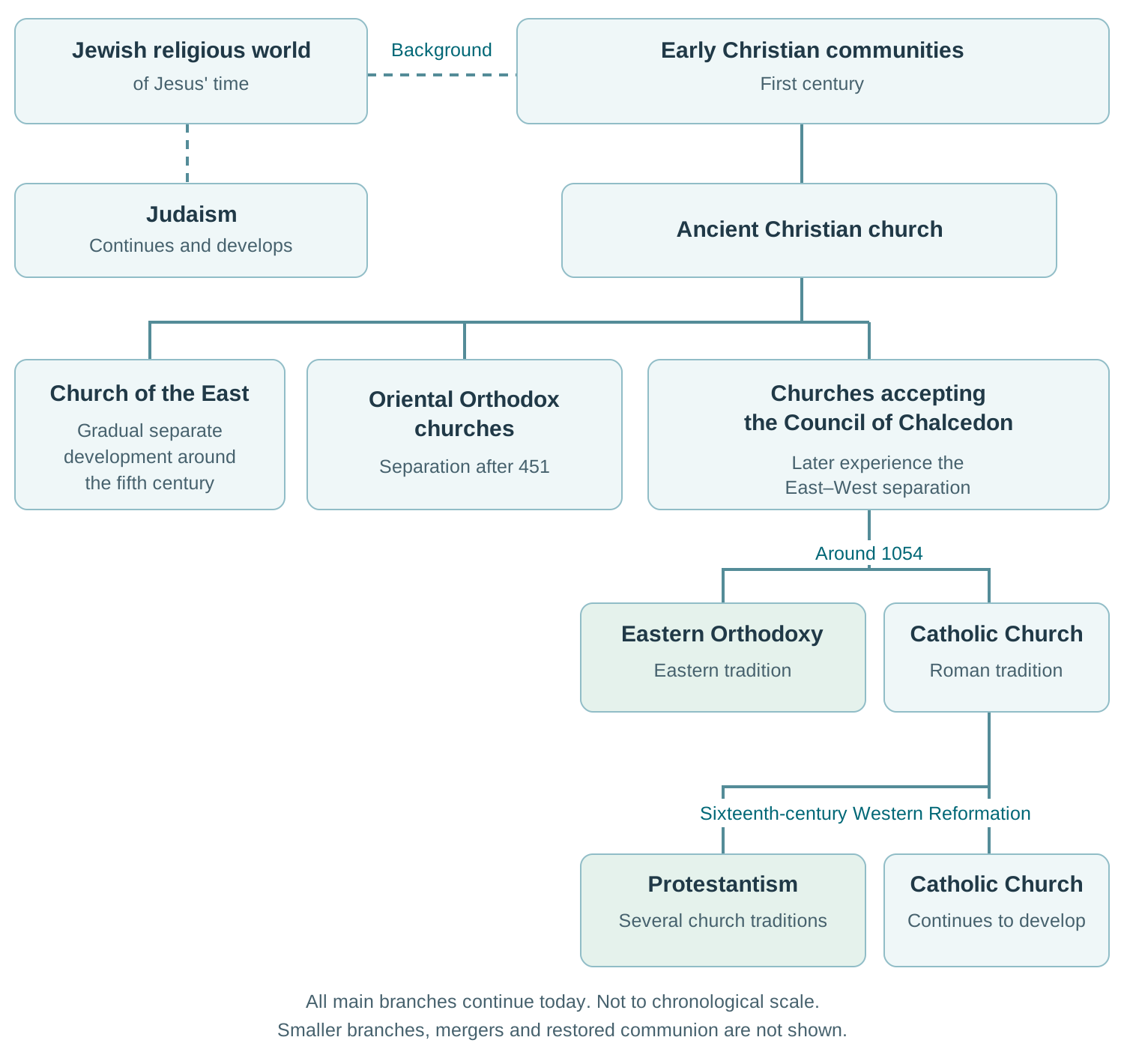
On a phone, scroll sideways to see the whole diagram, or tap it to open the full-size image and zoom in.
Diagram in words
- The Jewish religious world of Jesus’ time forms the background of the earliest Christian communities (first century). Judaism continues and develops as its own tradition.
- The ancient Christian church gives rise to the Church of the East (gradual separate development around the fifth century), Oriental Orthodox churches (separation after 451), and churches that accepted Chalcedon.
- The churches that accepted Chalcedon later experienced the East–West separation, conventionally marked around 1054: Eastern Orthodox and Catholic traditions both continue.
- The sixteenth-century Western Reformation led to several Protestant traditions; the Catholic Church also continued to develop.
Dashed lines indicate the Jewish background and its continuation. Solid lines summarise the transmission and branching of Christian church traditions. All the main branches continue today. The diagram is not drawn to a chronological scale and omits smaller branches, church mergers and the restoration of communion.
The main reasons for division
Why did they separate? Three different historical turning points
Church divisions often resulted from the interplay of doctrine, authority, language, culture and politics. They did not all arise from the same issue, nor did someone suddenly invent a new religion each time.
Fifth century | How are Christ’s divinity and humanity united?
The Church of the East gradually formed its own structures in Persia and elsewhere. Christological controversies around the Council of Ephesus in 431 were also part of the background to its separate development. Some churches did not accept the Council of Chalcedon’s formulation of Christ’s divine and human natures in 451. They later formed the Oriental Orthodox family, including the Coptic and Armenian churches.[6][7][19]
These two traditions are distinct from one another, and neither is what is usually meant by “Eastern Orthodoxy”. Their differences concern how to express the union of divinity and humanity; it would be misleading to say that one side denied that Jesus is God or human.
Around 1054 | Who has authority to lead the whole church?
The West increasingly emphasised the Pope’s universal jurisdiction, while the East valued joint decision-making by bishops. The West also added to the creed the statement that the Holy Spirit proceeds from the Father “and the Son”. The East objected both to its theology and to the procedure for adding it. Language, liturgy and political conflict deepened the differences.[5][8]
The mutual excommunications of 1054 were a symbolic event. The Crusaders’ capture of Constantinople in 1204 deepened the rupture. Both Catholicism and Eastern Orthodoxy continue the ancient church; they were not two religions founded that year.[5][18]
From 1517 | How should salvation, Scripture and church authority be understood?
After Martin Luther criticised abuses involving indulgences, the controversy broadened to grace, faith, justification, papal authority and the sacraments. Reformers and political authorities in different regions took different paths, gradually forming Protestant traditions such as Lutheranism, the Reformed churches and Anglicanism. The Catholic Church also pursued internal reform.[1][10][11][12]
Protestantism developed mainly in the context of reform in the Western church, not by branching off from Eastern Orthodoxy. Nor should the dispute be reduced to “one side relies on grace, while the other buys salvation”.[9][20]
Three key themes in brief:
Fifth century: Christology and the boundaries of the early churches.
East–West Schism: church authority, the creed, politics and culture.
Reformation: reform of the Western church, salvation and authority.
Denominations and cross-denominational movements
How are the names we hear today related?
Protestantism contains different denominations, but “evangelical” and “charismatic” usually describe a different level of classification. First, consider the historical relationships among denominations:
Name · Where did it come from, and what does it emphasise?
Lutheran churches
The sixteenth-century Lutheran Reformation tradition; emphasises grace and justification by faith.[10]
Reformed and Presbyterian churches
The Reformed tradition is connected with the Reformation in Switzerland and elsewhere. Presbyterianism is an important branch, emphasising shared government by elders and church councils.[11]
Anglican churches
A tradition formed during the English Reformation, retaining episcopal government and much ancient liturgy.[12]
Baptist churches
Rooted in seventeenth-century England and communities in exile in the Netherlands; emphasises baptism following a personal profession of faith and the autonomy of local churches.[13]
Methodist churches
Developed from the eighteenth-century Wesleyan revival within Anglicanism and later formed independent churches; emphasises sanctification and social concern.[14]
Pentecostal churches
Emerged in the early twentieth century and developed into several denominations; particularly emphasises baptism in the Holy Spirit, speaking in tongues and other gifts.[15]
These two terms can cross denominational boundaries
Evangelical: an orientation of faith
Emphasises Scripture, personal conversion, Christ’s redemption and evangelism. Found in different denominations, including Presbyterian and Baptist churches.[16]
Charismatic renewal: a cross-denominational movement
Emphasises present-day gifts of the Holy Spirit. It can appear in different Protestant denominations, and there is also Catholic Charismatic Renewal.[15][17]
“Independent” or “non-denominational” primarily describes organisational affiliation. These churches may not belong to a traditional denomination, but they still have their own doctrine, traditions and forms of government.[4][15]
For example, someone can belong to a Presbyterian church and also identify as evangelical, or be Catholic and take part in Charismatic Renewal. These labels are not all mutually exclusive.
Common questions and summary
Clearing up the most common points of confusion
Are Catholics Christians?
Yes. Catholicism, Eastern Orthodoxy and Protestantism all belong to Christianity. Confusion arises because everyday usage in Taiwan often reserves the Chinese term Jidujiao for Protestants.[3]
Is Judaism the earliest Christian denomination?
No. Christianity emerged from a Jewish religious background, and the two gradually developed into different religious traditions. Judaism did not disappear or collectively change its name.[2]
Are Eastern Orthodoxy, Greek Orthodoxy and Oriental Orthodoxy the same?
Greek Orthodoxy normally belongs to the Eastern Orthodox tradition. Oriental Orthodoxy is a different family of churches whose separate development began earlier. Similar wording does not make them the same tradition.[5][6]
Do churches differ only in name or style of worship?
No. There are substantive differences in church authority, Sacred Tradition, sacraments and some doctrines. Protestant emphasis on Scripture’s supreme authority does not mean that Catholics or Eastern Orthodox Christians do not value Scripture.[5][9][10]
Did dialogue stop after the divisions?
No. For example, in 1965 the Catholic Church and Constantinople removed the relevant excommunications of 1054; in 1999 the Catholic Church and the Lutheran World Federation issued a Joint Declaration on justification. Dialogue or agreement on some issues, however, does not mean that the churches have merged.[18][20]
The overall relationship:
Jewish religious background → Early Christian communities → Gradual divisions among ancient churches.
Catholicism, Eastern Orthodoxy and other ancient churches continued in their own traditions. The sixteenth-century Western Reformation then gave rise to several Protestant traditions.
Sources for further study
History and terminology: [1][2][3] Ancient churches and the East–West Schism: [5][6][7][8]Protestant denominations: [10][11][12][13][14] Contemporary movements: [15][16][17]Doctrinal and dialogue documents: [9][18][19][20]The main sources are Harvard University’s Pluralism Project, the World Council of Churches, official church accounts and joint declarations. Select a number to open the original source.